
An excellent article on how you can succeed and learn from the mastermind himself. The school of hardknocks is what helps you succeed in life and this piece explains it like none other.
read more | digg story
Sunday, June 29, 2008
Albert Einstein’s 7 Lessons from the School of Hard Knocks


Thursday, June 19, 2008
Upgrade an Unproductive Day to a Better Tomorrow
There’s no going back in time, but there are ways to learn from the past rather than live in it.
Every day we walk through a minefield of potential distractions, sometimes arriving on the other side unscathed, sometimes not. One digression leads to another, the cycle repeats, and hours later we wonder where the time went. It’s tempting to criticize ourselves for getting nothing none that day, and even if the criticism is somewhat accurate (it’s unlikely that nothing got done), the diagnosis itself is idle — which is to say, “So what?”
Figuring out the obvious moves nothing forward. On the other hand, recognizing the problem implies recognizing the solution. When I run into this situation, I ask myself to process questions:
* How did I get nothing done today?
* What will I do differently tomorrow?
Since a day’s accomplishments, or lack thereof, is the sum of many behaviors, neither of these questions can be addressed by a single answer — at least to have the level of precision necessary to make a substantial change.
Mental modeling
It’s not enough to know our worst practices in general. To make tomorrow a more accomplished day than today, we need to rewind the film strip to the precise moment where we got derailed.
For instance, I noticed that whenever I boot a computer and don’t seem to get straight to business, the problem usually starts at boot time. Since I can’t do anything on the laptop for two or three minutes, I start to zone out. What I would be doing if boot time wasn’t a factor is doing a daily review on the Palm Desktop, looking at each of my action lists.
Asking myself, “What would I do differently?”, it took about 10 seconds to realize that I needed to have my lists — especially my @Computer list — available before the computer was. So I started scanning my at least my @Computer list on my Palm Centro, so that by the time the hourglass on my laptop’s screen disappears, I can hit the ground running.
If I get a call before 9:30 am, it may take me 15 to 30 minutes to regroup after the call and get back to writing. So I’ve set my phone to turn on only after that time (an application called Phone Technician allows you to set your Palm smartphone’s connection times).
The basic idea is to mentally step through the day, looking for the forks in the road that compelled you to do X when you know in hindsight that you should have been doing Y. When was the precise moment what your attention shifted to the path of less resistance? What precisely was the distraction?
I believe the sequence of behaviors is critical, and that the earlier ones have the most leverage. If you can maintain a chain of focused activity in the first few hours, you create the momentum necessary to minimize the effects of distractions later on.
Sometimes the problems aren’t necessarily distractions, but behavioral patterns that yield predictably regrettable results. Having too many sugared foods or beverages in the morning leads to an energy crash in the afternoon. Driving past a great bookstore on the way home from work leads to the unbearable lightness of wallet. A change of environment or route may be in order.
Always make tomorrow a better day.
read more | digg story
Monday, June 9, 2008
Five Simple Ways to Relax at Work When Stress Strikes
Stress sucks. It is one of those things that can sneak up on you at work and explode in terrible and hurtful ways. When stress strikes it is really important to have some simple techniques in your arsenal that allow you to deal with the emotions in the short and long term.
read more | digg story
Sunday, June 8, 2008
6 Things Money Cannot Help you Achieve
Before you ride on the jet of euphoria and focus your entire life on earning money, know there are simply things that a roll of hundred dollar bills cannot get for you, not even if you are Mr. Gates.
1. Time: Money is a tool for trade. With that said, we spend a good chunk of our allotted time on this earth getting, spending, worrying and fantasizing about money. You can't buy the time and save it in your storeroom even if you are Mr. Gates. On the contrary, money takes away your time that could have been spent playing with your children or having a long walk with your alter ego. When the sun sets, a day goes away from our life forever. No money has power to bring that back to life.
2. Self Awareness: Ignorance is bliss, right? It's a curse. Not having self-awareness and self-consciousness lead to decisions that can cost you dearly. Well, the cost may be life itself. As a result, many people live a mediocre life without living for a true purpose. Their ignorance can't be transmuted into awareness with money. They believe that their ignorance is their awareness.
3. Self esteem: I have a plethora of examples to prove that no money can purchase self-esteem. Self-esteem is earned from within. If you are your worst enemy, gods of money can't rescue you from the self-destruction you inflict on yourself. King of rock Elvis Presley had the best life one can imagine with no dearth of cash. He took his own life with the deprivation of self-esteem.
4. Health: As I write this, I found out that Senator Kennedy has brain cancer, and it is terminal. Of course money can get him the best health care possible but no money can buy insurance for a life. We buy insurance for just about everything including our life but money can never bring life back.
5. Respect: Try this. Slap someone on his face and then hand him $100 to get his respect. Will you get it? I doubt it. We all live our life in pursuit of self-respect from peers, from family members, from our alter ego and even from strangers. No money can buy respect from others if our actions speak volumes about our negativity - insult, rudeness and lack of respect for others.
6. Happiness: This is controversial. Money can buy happiness if it is spent on to bring grater financial security for the family. However, money can't buy happiness if the purpose is to make money to make other people happy. The chase of possession of possessions can never find its destination with incessant desire to accumulate more possessions. Happiness comes from within. When we trade so much time and energy to get money, we deprive our inner self from the food of happiness.
I'm sure that you either are nodding you head in disbelief by now, or you've been enlightened by the revelation that, after all, money can't buy some of what matters most in our life. I'll be glad to get a zap or a hug from you.
read more | digg story
Thursday, June 5, 2008
The 60-Second Guide to Healthy Living
0:60 Create The Possibility of Being Healthy
Understand that the only time is right now, so no excuse of 'I'll only cheat once', or 'I've been good all day, why not?', is going to be good enough. Each time you put food in your mouth, you must treat it as the most important time.
0:55 Differentiate Between Healthy and Unhealthy Foods
If it's a plant-based whole food it's good morning, night, and day. If it's full of grease and fat, it is a no go -- no matter what. Keep the meats lean, preferably chicken and turkey, and no red meats.
0:50 Take Inventory of The Refrigerator
Go through your refrigerator and food cubbies and look at the type of food that you are currently harboring. Compare this to the food that you decided is healthy -- get rid of the rest.
0:45 Water -- Choose
Make a decision that the only beverage that you will allow past your lips is water. It's the original, and is still the best. Forget sodas, processed juices, coffees, teas, and alcohols -- you'll be amazed by the difference.
0:40 Trade Inhaling For Chewing
Often times we're in such a hurry to feel satiated and go about our daily business that we forget that food is supposed to give pleasure. By taking the time to chew, we can love food and have it processed into easily digestible tiny bits at the same time.
0:35 Get Accountable
When your willpower is questioned, it helps to have people in your life to keep you accountable. This is the same reason why personal trainers are so effective -- because they make you do it. Figure out who is close enough to you to give you critical feedback.
0:30 Pledge To Under Eat
I'm not talking about starving yourself, I'm talking about eating to the point before you feel full. This point greatly aids in digestion and is the number one habit of people with quick metabolisms and low body-fat.
0:25 Eat Often
Hand-in-hand with not overeating is eating often. Having small meals 5-6 times a day that you might think of as snacks instead of meals. It will help you stay slim and keep you alert after your meals instead of lethargic (the tiredness after a big meal).
0:20 Say 'No'
Whenever an unhealthy food option presents itself, say no. Do not think of it as restricting yourself, think of it as an opportunity to strengthen your resolve to be disciplined and think of it as doing a really good thing for your health.
0:15 Consider Cardio
Cardio is great for losing weight (which could be a problem for people trying to bulk up) but it's absolutely essential to keep yourself healthy (especially a healthy heart). Commit now to walking at least 4 times a week for 30 minutes each time, or running 3 times a week for at least 20 minutes.
0:10 Breathe
Breathe because this has been an intense 60 seconds and because breathing will reduce stress, which will decrease the cortisol being released into your body, and ultimately decrease stress related diseases. Make a commitment to meditate for 15 minutes each morning when you wake up for ultimate stress relief.
0:05 Celebrate Victory
Do a little pre-victory celebration; you deserve it. You now know everything it takes to live healthy. All you need to do is go out there and do it.
read more | digg story
Tuesday, June 3, 2008
7 Ways To Manage Your Email Like An Expert
For the rest of you, here are the ways to manage your email like an expert:
1. Set a time frame: This is very important; it is easy to lose track of time while checking your mail. In between the deleting and replying, you simply lose track of time and find later that 4 hours has slipped by. You could probably set 3 slots of 20-30 minutes each, during different times of the day, to check your email. Use reminders or other time tracking tools to keep track of your time.
2. Use Gmail: If you are using a different web based email then waste no time in switching to Gmail. It will make you much more productive. You could also switch to Gmail without changing your original email address, which is probably preferred. Here is an article that explains how to do it.
I advocate the use of Gmail, not as a die-hard Gmail fan, but as someone who has tried out various email clients in the past 5 years and found that nothing else compares. It has some amazing features including filters and keyboard shortcuts and if you use a desktop client like Outlook or Thunderbird, then Gmail also provides for IMAP access which makes life easier.
3. Prioritize using Labels / Folders: It's important to differentiate the important mails from the unimportant ones. If you use Gmail, then you can set filters which will do the job automatically by applying labels or re-routing the incoming mail. In all the other email clients, there are folders which you can use to prioritize your email as well. You can make folders named "friends", "Reply today", etc. and when you open your inbox, immediately start shifting mails to their respective folders.
4. Be Precise: Be precise and to the point when answering emails. You could even skip 'Hello' and 'Regards' if you want; I don't think anyone will mind it. Learn to use one-liners effectively. If you use web-based email and Firefox as your browser, then there are some add-ons like Paste Email which helps you to paste repetitive texts in forms or emails with one or two clicks.
5. Delete Ruthlessly: You can easily conclude from the subject line of an email if it's worth reading. If it isn't, delete it without thinking twice. If you slack, thinking that you probably might read it later, then believe me, that email will remain there as unread until you finally decide to do away with it. Act upon the email the first time you see it by either responding immediately, deleting it, or setting it as a task to accomplish at a specific time.
6. Don't leave it for the next day: Try and finish replying to the emails and clearing your inbox within the time frame you decided. I know, it's not always possible, especially if you get more than 100 emails a day, but if the emails go pending then the next day it becomes much more difficult for you to sift through your inbox. Think of your inbox like a snowball, the more it rolls, the larger it gets.
read more | digg story
So What Really Is The Meaning of Life?
What is adding value?
Ask 100 people what they think gives meaning to their lives and you will get 100 different responses. Money, property, a successful career, a big car, an attractive spouse, partner,… But I’m sure most people would agree that these things in themselves do not add lasting and profound meaning to us.
Albert Einstein said that ‘only a life lived for others is a life worthwhile,’ and I believe that a life of service to others is what truly brings meaning.
The term ‘service’ may suggest that we have to give up our jobs and money to go help the poor and destitute. I know several people who have done just this, and they have certainly found happiness and peace in their choice of lifestyle. But a life of adding value does not mean abandoning your own needs and desires. It is not the same as sacrifice; far from it. When we truly add value to the lives of others, we cannot help but receive value ourselves. Adding value is the only real way to live a meaningful life.
Love what you do
So the question remains: How can we add value? I believe the answer to this is surprisingly simple.
To quote Steve Jobs in a speech he gave in 2005:
‘Your work is going to fill a large part of your life, and the only way to be truly satisfied is to do what you believe is great work. And the only way to do great work is to love what you do. If you haven’t found it yet, keep looking.’
Through Apple, Steve Jobs has undoubtedly added immense value to the world. He did it by following his heart and has been richly rewarded for it. The same can be said for many famous, successful and wealthy people.
Loving what you do means starting right here, right now. Whatever you are doing, you can start to love it.
Of course, you’re not suddenly going to love a job you’ve hated for years. In fact, if you hate your job so much then you probably ought to leave. But it’s unlikely that there is no aspect of your job that you like. The trick is to identify these good bits and focus on them, making them more central to your experience. And the things you don’t like? Can you find any redeeming qualitative in these things? Can you change your attitude so that you see these tasks as useful or meaningful?
If you can start to love what you’re doing, then you’ll be adding value in some way.
Do What You Love
Interestingly, Steve Jobs didn’t say do what you love. He said love what you do. You don’t have to quit your dull nine-to-five job and start all over again. But doing what you truly love certainly has its rewards. In Making a Life, Making a Living, Mark Albion cites a study carried out by Srully Blotnick. The careers of 1,500 business school graduates were tracked from 1969 to 1980 and were split into two groups: group A said they wanted to make money first so they could do what they really wanted later, and group B said they would follow their interests first, regardless of financial considerations. At the end of the study, there were 101 millionaires. All but one came from group B.
read more | digg story
5 Common Obstacles That Keep You From Reaching Your Goal
Let's take the example of starting an Internet business as our model to see how to overcome your obstacles. Here are 5 of the most common ones you may come across while seeking your goal:
1. Too much information. You've read the books, taken the teleclasses, and studied the websites. You're on information overload, so you go into analysis paralysis. Which means you do nothing. Solution: Pick one person to study and go with that model. One of the earliest Internet success stories was Corey Rudl, and after he died, Derek Gehl took over. So if I were building an Internet business, I could choose him as my role model, and read his website, his ezines, buy his products, and take his courses.
2. No clear plan. Many people get lost after they decide to pursue a certain goal. Most goals are merely a progression from where you are to where you want to be. You need a clear plan from A to Z so there's no guesswork. Solution: Derek Gehl, for example, has a 30-step action plan that can keep you on course.
3. Shortage of time, money, or other resources. We often are enthusiastic about achieving a certain goal, but fail to do our homework before embarking on the course. Solution: Before you set out on your goal, figure out the amount of time you will need to put into this, the costs you will incur, and the resources you will need to obtain and use. For our particular goal of launching an internet business, these could include software for auto responders, shopping carts, and eBooks, a copywriter to write your sales page, and at least 2 hours a day to learn the specifics of online marketing.
4. Mindset and attitude. If you don't have the mindset and attitude of a winner, you have less chance of succeeding. Solution: Find successful online marketers and study them. Talk to them. Listen to their language. Adopt the mindset of success by thinking and speaking positively. Adopt the attitude of success by seeing obstacles as opportunities and setbacks as feedback.
5. Lack of support or guidance. You may hit some roadblocks and get stuck, not knowing what to do next. On any journey, support and guidance are essential. On a road trip, it's your map or GPS system. For an online business it's experienced marketers. Solution: find a mentor, coach, teacher, friend, joint venture partner, anyone who will hold your hand, guide you, support you until you reach your goal. Then you can celebrate together!
read more | digg story
Monday, June 2, 2008
3 Steps to Success: Thinking, Acting and Breaking Up the Day
"I usually take a two-hour nap from one to four."
- Yogi Berra
3 Steps to Success: Thinking, Acting, and Breaking Up the Day
By Michael Masterson
For the past few months, I've been sharing some of my personal productivity secrets in a series of articles to help you "Master Plan" your life so you can finally accomplish all your goals. Ultimately, it all boils down to how you spend your time. What you do and what you fail to do.
Setting goals is easy. Establishing priorities is pretty simple too. The tough part is following through. Fortunately, there are a few easy steps you can take to coach yourself through the process.
1. You must recognize that good intentions are not enough.
Writing up a list of yearly goals or New Year's resolutions might make you feel great. It may even make you feel like you are on your way. But you can't claim to be making any progress toward accomplishing anything until you start acting on your Master Plan.
2. Don't spend too much time thinking about your future success.
Imagining what you want out of life - the big house, the luxury cars, the yacht - may give you pleasure. But despite what the think-and-be-rich gurus says, it won't make you successful. You must spend most of your time taking action, not daydreaming about all the toys you will have "some day."
Most of the most accomplished people I know - and in that group I include some success coaches who preach the think-and-get-rich philosophy - don't waste their time thinking about success. What they think about is how to do a certain task or solve a specific problem. They know that wealth and success will come to them if they have a good plan and follow it.
3. Break up your busy day.
Once you begin to implement your Master Plan, you will find that you will want to keep working for hours and hours at a time. Because you will be making progress toward your goals, you will be energized by the work itself. (If this has not been your experience with work before, be prepared to start enjoying your days a whole lot more!)
The extra surge of motivation will be very useful in getting lots more important work done. You'll be working more intensely, more intelligently, and just plain longer and harder than ever. But because you'll be working longer and harder, you'll need to force yourself to take little breaks - three- to five-minute breaks to reduce stress, recharge your batteries, and ensure that your body is not stuck in the same position too long.
It's not easy to take breaks once you are in a groove. In fact, you may be amazed at how difficult it can be. Most of the successful businesspeople I know think nothing of sitting at a computer or being on the telephone for four to six hours at a stretch. This is a testament to the motivational power of having a Master Plan, but it still puts a lot of pressure on your body and brain.
To make sure you take the breaks you need, I recommend a very simple device: an old-fashioned egg timer. Gene Schwartz, the legendary copywriter who was instrumental in the success of Boardroom Reports and Rodale Publishing, never sat down to work without setting an egg timer for 33 minutes. When the buzzer went off, he walked away from his computer and did something else for five minutes. He said the habit made him more productive. He said it was an important part of the process that made him a success.
When I'm writing, I set my timer according to the writing objective I've set for myself. Since I'm currently working on many writing projects at once, my daily goal is usually between 300 and 1,200 words. It takes me, on average, about 10 minutes to write 100 words. Therefore, I can knock off 300 words in a half-hour, 600 words in an hour, and a full, 1,200-word ETR article in two hours.
That's how I break up my time - in half-hour or hourly segments with an occasional two-hour sprint. Between segments, I usually stretch backward and forward over a Pilates barrel I keep outside my office. Sometimes I'll go outside and just breathe in the fresh air.
My afternoons consist of meetings and phone calls, which have natural breaks so I don't need my egg timer. (I schedule most of my meetings for 15 or 30 minutes. It is seldom necessary to have a meeting any longer than that.)
Like Gene Schwartz, I have found my mini-breaks to be very refreshing.
Sometimes, if I had a short night of sleep and an intense midday workout, I get very tired in the middle of the afternoon. When I feel that way, I lie down and try to nap for 15 minutes. I will do that anywhere and under any circumstances. I'm not embarrassed by it. I think people who don't understand it should be embarrassed, not me.
Once, suffering from jet lag in London, I lay down on the floor underneath the conference table before a board meeting. Fifteen minutes before the meeting was to start, NR, a board member and multimillionaire German publisher, came in. Our eyes met. I thought he might say something. Instead, he took off his shoes, lay down next to me, and we both enjoyed a power nap.
To help alleviate the boredom of working in one place all day, I split my time between my home office above my garage (where I do my writing in the morning) and my office at ETR headquarters. I have outfitted both offices with efficient workstations and comfortable chairs. And I have pillows handy in case I need a nap.
In the late afternoon, after a good day's work, I often reward myself by walking over to a cigar shop two blocks from ETR. I can do some additional writing there while enjoying an espresso and a fine Nicaraguan cigar.
I get home at 7:30, open a bottle of wine, and head to a favorite spot in the backyard where I do some light reading and/or solve a crossword puzzle. It gives me a chance to unwind and, if necessary, blow off a little steam. Sometimes, I'll jump in the hot tub. The idea is to get into a good mood for dinner, which starts promptly at 8:00.
All these little breaks and naps and rewards enhance the pleasure of my day. No matter how much work I have on my task sheet, I'm never more than two hours away from some pleasurable experience.
If you find that your workday is one long trek down a dull road, try breaking it up the way I do and see if it doesn't make you happier and more productive
Thursday, May 29, 2008
Link between income and happiness is mainly an illusion
While most people believe that having more income would make them happier, Princeton University researchers have found that the link is greatly exaggerated and mostly an illusion.
"The belief that high income is associated with good mood is widespread but mostly illusory," the researchers wrote. "People with above-average income are relatively satisfied with their lives but are barely happier than others in moment-to-moment experience, tend to be more tense, and do not spend more time in particularly enjoyable activities."
The Princeton researchers collaborated with psychologists David Schkade of the University of California-San Diego, Norbert Schwarz of the University of Michigan and Arthur Stone of the State University of New York-Stony Brook.
The researchers have developed a tool to measure people's quality of daily life known as the Day Reconstruction Method (DRM), which creates an "enjoyment scale" by requiring people to record the previous day's activities in a short diary form and describe their feelings about the experiences. Their 2004 study using this method, which surveyed 909 employed women in Texas, provided evidence that higher income played a relatively small role in people's daily happiness.
For the new study, the researchers examined data from the 2004 survey to illustrate misperceptions that more money buys more happiness. Their experiment extended previous studies in which people have exhibited a "focusing illusion" when asked about certain factors contributing to their happiness -- attributing a greater importance to that factor once it has been brought to mind. For example, when people were asked to describe their general happiness and then asked how many dates they had in the past month, their answers showed little correlation. But when the order of the questions was reversed for another group, the link between their love lives and general happiness became much greater.
To test whether this illusion applied to income, Krueger, Kahneman and their colleagues studied the responses given by the women in the 2004 DRM survey. After they were asked to report the percentage of time they spent in a bad mood the previous day, they were asked to predict how much time people with certain income levels spend in a bad mood.
Survey respondents expected women who earned less than $20,000 a year to spend 32 percent more of their time in a bad mood than they expected people who earned more than $100,000 a year to spend in a bad mood. In actuality, respondents who earned less than $20,000 a year reported spending only 12 percent more of their time in a bad mood than those who earned more than $100,000. So the effect of income on mood was vastly exaggerated.
To provide further evidence on the role that income plays in people's lives, the researchers conducted an additional DRM survey of 810 women in Ohio in May 2005. In this survey, respondents reported their experiences from moment to moment as well as their annual household income and overall life satisfaction. The new survey found that income was more weakly correlated with individuals' happiness from moment to moment than it was with their overall life satisfaction.
"If people have high income, they think they should be satisfied and reflect that in their answers," Krueger said. "Income, however, matters very little for moment-to-moment experience."
read more | digg story
How to live to 100 years old
It's believed that Okinawa has the world's largest number of centenarians, with 50 people per 100,000 aged more than 100 years. In most developed countries including the USA, the rate is between 10 and 20 per 100,000.
One of the factors contributing to Okinawans' longevity, a study shows, is their diet - low in saturated fat but high in seafood, seaweed, fruit and vegetables.
Another striking factor is their low intake of calories, due to a cultural tradition called "hara hachi bu" meaning "eat until you are only 80-per-cent full", which is widely practiced in Okinawa.
The Okinawans consume about 500 calories less than the typical 2,000-plus-calorie diet eaten daily by an adult woman in a Western country.
Based on the Okinawan experience, it can be safely said that the ageing process is influenced by a variety of genetic, environmental and lifestyle factors. While we can't control all of these, there are lots of things we can do to increase our chances of living longer.
1. Stay active - exercise not only helps keep body fat levels down, it also keeps the brain active. A US study of 6,000 women aged 65 years and above found that those who were active tended to retain their cognitive function better than those who were sedentary.
2. Watch calories - while a severe reduction in calories is not advised if you are normal weight or underweight, try to concentrate on wholesome foods like fruit, vegetables and whole grains, and aim to keep off the kilos.
3. Load up on fruits and vegetables - the more brightly coloured the better. Fruits and vegetables are rich sources of bioflavenoids and other antioxidants, which are known to help neutralise free radicals.
4. Choose good fats - moderate amounts of mono-unsaturated fats (olive oil, canola oil, fatty fish, nuts, seeds, flax). Eat fish two to three times a week.
5. Get enough sleep - a lack of sleep increases the risk of obesity and can affect metabolism and hormone production. Aim for at least seven to eight hours a night.
6. Moderate alcohol - high alcohol intakes are linked to increased body weight and other health issues including certain cancers. If you drink alcohol, limit yourself to just one or two drinks daily and aim for two alcohol-free days a week.
7. De-stress - whatever works for you: meditation, yoga, religion, a simple cup of tea or a walk in a garden.
8. Don't smoke - smoking is linked to an increased risk of cancers, heart disease and stroke.
read more | digg story
Wednesday, May 28, 2008
Create a Richer Life in 24 Hours or Less
Thank goodness there are two types of riches or wealth that define our lives: there's being financially rich and there's being life rich -- one doesn't necessarily exclude the other. You can be both at the same time, at different times, or at no time.
Here's how to make yourself richer in 24 hours or less.
1. Be thankful for life. Every single one of us takes for granted that when we go to sleep at night, we're going to wake up the next morning. I'm not trying to frighten you, but to make you understand how thankful you should be for every single morning you open your eyes because it's not a guarantee that it'll happen. I know you don't think about it because when you wake up, you've already got a ton of things on your mind.
Well, stop. Lay in bed for a few seconds and just be thankful that you've got another day because they're so few in number.
2. Make a new friend. True, it's tougher for adults to make friends than it is for kids. When you were a kid you could easily walk up to whomever had a new toy at the playground and he was instantly your new best friend. However, for adults, friendship too often comes with more strings attached than a marionette show. We tend to see friends as people who can help us achieve something rather than another soul to be enjoyed.
Well, life is nothing if it isn't about relationships, and friendships are the easiest to come by if you're willing to put forth the effort.
3. Count your blessings. Okay, I know it's a cliché, but if you truly want a richer life, then you have to be thankful for what you already have. And don't tell me that you have nothing because no one truly has nothing. You can be living on the street with only a garbage bag full of possessions, but as long as you still have breath in your lungs, you have opportunity. The world is filled with examples of people who appeared to have nothing left to live for only to rise up and show everyone what life is all about. Stephen Hawking, anyone?
4. Try living life instead of surviving it. How many of you feel like you just went 12 rounds with the champ at the end of each week? How many of you really need a weekend on the couch just to store up enough energy for Monday? If this sounds familiar then you're not living life, you're surviving it - and that's no way to live.
You don't have to fill up your entire day with work to be worth something. I'll tell you right now, for nothing, that you could spend a week earning ten thousand dollars and it wouldn't be worth as much as spending an hour with your kid, your wife, as a Big Brother or Big Sister, or as a volunteer to a family in distress.
Leading a rich life has absolutely nothing to do with the amount of money and stuff you leave behind when you're gone - the universe really doesn't care about that. Rather, it's about the effect you had on those around you. That's what lasts and gets passed on forever.
What little things do you routinely do to make you feel great inside?
read more | digg story
Tuesday, May 20, 2008
7 Ways To Have The Greatest Day of Your Life
The greatest day in your life and mine is when we take total responsibility for our attitudes. That's the day we truly grow up.~John C. Maxwell
1. Decide that fine is bad. Fine means you aren't growing or swimming, which means that you are shrinking and sinking. Fine is being average, it's being defeated, and it's giving up. Fine means that nothing outstanding happened to you today and you should know that you deserve something miraculous in your life.
Fine is also a relative term. A billionaire could feel fine about making only 2 million dollars today, or a middle class man could feel fine about having 3 square meals today. A poor person would be delighted out of their mind at a couple million bucks and a starving person would jump up and down at the thought of 3 square meals. The point is to decide what's fine for you and do everything in your mind to exceed this level.
2. Relationship with self. Become aware of everything that had to happen in the universe in order to put your here right now. The big-bang, God, evolution, the earth revolving around the sun, the right sperm reaching the egg at just the right time. The fact that you are standing here is impossible!
You're worth more than diamonds, castles, and spaceships and it's taken too many perfect coincidences to bring you here. On this day, when you become conscious of your self-worth, and acknowledge it as being more than you have ever said it to be before, you are having the greatest day of your life.
3. Upgrade yourself. Become conscious and aware of your skills, talents, and character traits. Make it a point to become a little bit better. A better person, friend, artist, investor, parent, writer, or anything else that is important to you.
When you've chiseled your character, sharpened your skill, or expressed your talents more so than ever before, you will have the greatest day ever. Such self-improvement, sitting on the shoulders of all previous self-improvement, will allow you to have the greatest day ever.
4. Create huge possibilities. I've mentioned that striving for greatness could lead to a misfire and leave you off at awesome instead of best. Keeping this principle in mind create the biggest goals, dreams, and possibilities that you have ever made for yourself or your life.
Think bigger and better than ever before. It is right now, during the planning and within the possibilities that you will have the greatest day of your life.
5. Love your hardest. Love with more energy and passion than you have ever loved before. Listen harder, spend more time, and create greater workability in your relationships than on previous days.
Do something unique, caring, or fun for the ones you loved. Just love them with all your might. When you've loved harder than you've ever loved before, you will have the greatest day of your life.
You certainly can prepare for the greatest day of your life by making sure you will be filled with vitality. Do this by drinking plenty of water the day before and the day of, doing some cardio to spread the endorphins throughout your body, and getting the right amount of rest for your body.
read more | digg story
Monday, May 12, 2008
Your Mid-Life Crisis: The Rule
Sooner or later we all go through it. We begin to lose parents, our friends or spouses start to come down with "old people" illnesses, our children grow up and (if we're lucky) begin to leave home. We look around at the landscape of our lives and realize it has become unrecognizable. ...Here are the rules for what to do
* Don't panic. Just because the end seems suddenly near, don't feel that you have to totally change your life in an instant. The truth is, you still have plenty of time left. If you want to wisely make the most of that time, well-thought-out decisions are the way to go. You can't choose wisely when you're panicking.
* Do take time to relax. Feelings of panic and time-pressure can easily push you into making faulty choices (think convertibles, fake tans, face-lifts and torrid affairs). This is the time to start meditating, learning yoga or taking an occasional walk in the woods to calm yourself and clear your mind.
* Don't simply react to what you are feeling at the moment. While living in the present moment is normally a good thing to do at this point in your life, you don't really want to ignore all of the wisdom you have gained from past, as well as current, life experiences. Really, do you want to act rashly and make the same mistakes all over again?
* Do take a look into the past. Take time to evaluate where you are and where you have been. Look back over your life. What were the highlights? What did you enjoy? What didn't you enjoy? What lessons have you learned? Based on this you can decide what you want more of in your life and what you might want less of.
* Don't try to be someone you're not. You might feel like this is the time to let loose and really live, and it may be. But quitting your job and running away with some young lover may not be the best approach. If you value security and intellectual conversation, you're bound to be miserable. Anytime that your goals and life choices don't match up with your personal values, you're going to either fail, or be unhappy, or both.
* Do focus on your values. We tend to think that this is a no-brainer, but it's not. Sometimes, we lose sight of what we really see as important. Sometimes, we try to value what others say is right and good. It's important to take time to think about what you as an individual hold dear. Do you really place a high value on family time and time spent doing volunteer work or do you do it because everyone else values it? Would you perhaps rather spend your time reading and painting and writing? Your choices need to be consistent with your values to make you happy.
* Don't bury your fears of death or failure or loneliness. These are all valid emotions that need to be dealt with head on. Burying them leads to self-destructive behaviors, the last thing you want when you are trying to make the most of the time you have left.
* Do ask yourself what you fear most. What is it about being this age and going through these changes that scares you the most? Are you afraid that you will die alone? Do you fear that you will never write the book you always wanted to write? Are you worried that bridges burned will never be repaired and you'll die with your (children, ex-wife, sister) hating you? Are you afraid that you'll never experience anything exciting and die of boredom? The answers to these questions can help you to determine what really is most important to you. They can help to give the remainder of your life focus and you a sense of purpose.
read more | digg story
Tuesday, May 6, 2008
The Fast Track To Being A Winner - Dumb Little Man
With everything being so gosh darn important we set about to create lofty goals. We realize that in order to achieve we must be a certain type of person to perform the actions necessary to succeed. The person we must be is a winner.
Type A (Winner) Personalities
Winner, we will define as, a type A, get-it-done, care about other people, type of personality. This is the type of person that everyone wants to be around, the type of person that everyone wants to be. Here are 10 traits that I would define as necessary to being a winner.
1. Exhibit Integrity
2. Do Not Speak Badly of Others
3. Stay Optimistic
4. Help Others When You Can
5. High Ambitions
6. Kind and compassionate
7. Believe in and respect yourself
8. Persist until you succeed
9. Open mindedness
10. Take responsibility
Fast Track To Being A Winner
You know you have some huge goals and you've been wanting to be a winner since you were 5 years old; you're just like me. You realize that there are 10 important traits to being a winner and many other traits that you would like to adopt as your very own in order to live a happier, more successful, more productive, and more rewarding life. Here's what you can do...
Act as if' you are a public figure! What does this mean? It means that you must understand that people are watching you at all times. Act as if it matters that people are watching you, and that you have a reputation to uphold, and you must act in such a manner so that people do not discover that you are anything different than what you appear to be.
This creates a sense of obligation in yourself to uphold the characteristics that you set out to identify yourself with. This way, no matter where you are, you are always thinking about how you are being a winner, and what kind of example you are setting for the people around you. Whether you are at work, happy hour, with your family, or at any public place -- be a winner.
Life is nothing but a series of habits, good or bad, that we have set up for ourselves. By being very consistent with being a winner and performing the actions of a winner, we are making 'winner' a habitual quality for ourselves. With time it won't be 'acting as if' and it will be 'going about your ways'.
read more | digg story
Thursday, May 1, 2008
Great article for everday ways to give more...
I think about Karma a lot, this aricle gives u ways to improve your karma by helping those around you, even if your karma doesn't go up, you'll feel like you're a part of the world more.
Here's a list of 5 small things that you can do to positively affect the lives of the people that surround you daily, but whom you may not ordinarily notice.
* Take time to say good morning to elderly people. People in their golden years are often alone and craving human contact. The two seconds it takes to say good morning and smile can change their entire day.
* Talk to your cleaning lady. Your cleaning lady is a person. Take a moment to ask her how she is and listen when she answers. Tell her you think she's doing a wonderful job and that you really appreciate her. She'll be the most loyal cleaning lady you have ever had.
* Buy a homeless person a cup of coffee and a sandwich. Nothing more to add here. Even if they are sleeping, just leave it next to them. It will warm their heart, if not their belly.
* Tell an older woman she is beautiful. For many women, getting older means feeling that you are 'losing your looks'. This can be extremely distressing. Telling an older woman she looks stunningly beautiful can make her whole year. Do it and watch her smile.
* Make friends with someone less fortunate than you. This can be via volunteering or just simply spending time with someone you already know. The dividends on this kind of giving are infinite and you truly will make a difference.
Remember, the smallest things can have the biggest impact on the lives of others.
Be kind. Don't be blind. Give.
read more | digg story
Monday, April 28, 2008
What laptop does Steve Ballmer use for his presentations?
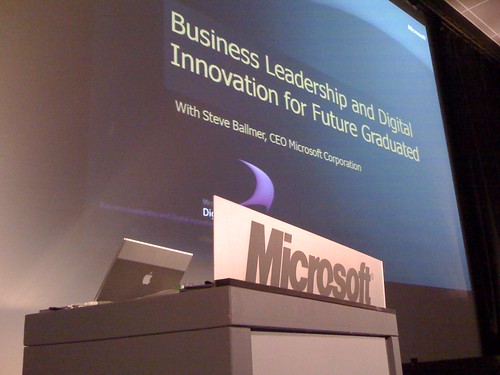
What laptop does Steve Ballmer use for his presentations? Right...
read more | digg story
Beating Procrastination is Easy – Once You Get Moving
An important aspect of any self improvement program is learning to overcome the fine art of procrastination. Some people are able to casually avoid an unpleasant or difficult chore, while others go to extreme lengths devising outlandish mechanisms for escaping their responsibilities. In many cases, the effort spent avoiding the task far exceeds.
# Unfinished Business Causes Stress: No matter how steadfastly you try to ignore those unpleasant responsibilities, the fact is they are not going to go away without your attention. One of the goals of any effort towards achieving self improvement is the ability to reduce stress – but until you learn to overcome your procrastination, any unfinished business will add stress to your life.
Undone tasks will lurk in the back of your mind, causing you to feel guilt and frustration. You will be ill at ease until you finally get around to completing any unfinished business you may have. As unpleasant as it may be, you need to dig in and make sure you address each and every responsibility and task in your life. Failure to do so will undermine any effort you make at achieving relaxation and fulfillment.
# Make the Most Difficult Tasks Your Priority: One of the best ways to get past your mental roadblocks regarding certain tasks is to move them to the top of your priority list and focus all of your energy on them. Make them your first accomplishments of the day, the week, or the month. Once you dive in and finish them, you can clear them off of your calendar, take a deep breath, and go about the rest of your business with a clear mind and a light heart.
By tackling the hardest things first, you complete them with and energetic body and a refreshed attitude, giving you the greatest chances of achieving success. You will feel a sense of great accomplishment, and somehow the rest of your chores will not seem so difficult.
# Just Do It: The easiest way to beat procrastination once and for all is to commit to just getting it done. Choose a starting point and dig in with both hands. If it helps, break your major tasks into smaller parts, creating a succession of smaller tasks that lead to the fulfillment of one major task. Breaking it down into smaller parts is a great mind trick that fools you into thinking you are completing something much easier than the original project appeared to be.
Once you know where you are going to start, then get moving. They say to have to walk before you can run, so just take it slowly and accomplish one step at a time. As you complete each step, take a moment to acknowledge your progress, then continue on. Do not allow yourself to become sidetracked, which is really just another avoidance mechanism. Commit to keeping yourself on task until the entire project is complete.
read more | digg story
Sunday, April 27, 2008
Monetizing Blogger
Blogger is probably the easiest blogging platform to monetize. Why? Basically because it's Google-powered and it has page elements that make it easy for you to customize your blog, as well as an Adsense page element.
Google AdSense is a fast and easy way for website publishers of all sizes to display relevant Google ads on their website's content pages and earn money. Because the ads are related to what your visitors are looking for on your site — or matched to the characteristics and interests of the visitors your content attracts — you'll finally have a way to both monetize and enhance your content pages.
It's also a way for website publishers to provide Google web and site search to their visitors, and to earn money by displaying Google ads on the search results pages.
Get it? If you had a site, even a free-hosted blog such as this one, you can be a publisher of their ads and earn money through it. I haven't cracked the Adsense code yet, and still in the process of fully understanding it, but I have earned something through it. Right now, I'm not planning on becoming a full-time publisher of the ads just yet, but God-willing, if my predictions are gonna be right, I might not have to have a job anymore and just live off of Adsense.
I can't go in-depth with discussing Adsense right now, because that would veer away from the broader topic, which is monetizing Blogger. I might as well just make a little list of what I know so far.
Monetize via:
1. Adsense
2. Any other ad publishing sites
3. Paid Posts
4. Affiliate Marketing
5. Selling your own products
About ad-publishing, please, I mean, PLEASE, read the Terms of Service before agreeing to it. This is so that just in case you think of something, you would know that it is either in violation or not of the TOS.
For example, if you are a publisher of Adsense and of course you find out that you get paid via clicks on your ads and then you have this epiphany of wanting to click your own ads in hopes of generating income for yourself. This is what I have to say about it.
DO NOT EVEN DARE HOVERING YOUR MOUSE POINTER OVER YOUR OWN ADS! ESPECIALLY IF YOU ARE PLANNING TO CLICK ON THEM.
Seriously, you don't want to be banned by Google for violating their TOS. If you continue to "fool" Google by clicking on your own ads, chances are the advertisers are wasting their money advertising their sites for bogus clicks, and Google has very low tolerance about false clicks. I stated above to not even dare to hover your mouse above the ads, because well, accidental clicks happen, and well, you know that sh*t happens too.
Wow, this is turning out to be a long series of posts. Stay tuned for more. I am so not done yet.
read more | digg story
iBand makes music with two fingers and iPhone
VIENNA, AUSTRIA - SIX fingers and three iPhones are enough to create a band, and Austria's iBand is living proof, having scored a hit on the Internet by converting the little gadgets into a guitar, a keyboard and a set of drums.
The Viennese trio first gained attention in February on the video-sharing website YouTube with its music video "Life is greater than the Internet."
The clip, showing a bird's eye view of six hands wearing fingerless gloves and typing away at three touchscreens, has since been viewed over 2.8 million times.
"It was a test, we were rather surprised by all these viewings, but of course it's flattering," Seb, the "drummer," told AFP.
Fascinated by the pocket-sized gadget's possibilities, the three members of the band, all in their mid-20s, imported Apple iPhones as soon as they went on sale in the United States in December and began experimenting with the accompanying software.
"The idea was there even before the software existed," said Marina, an arts and communication student who is the band's singer and "pianist."
The iPhone is very easy to play, says the band, which has composed three pop songs.
"Of course the screen isn't very big and it doesn't have all the advantages of a real instrument," says Marina's brother Roger, the band's "guitarist".
"But I can change the settings any way I please. For instance, I can play two different notes on the same guitar chord at the same time. And as long as there are new programmes, there will be new sounds," he added.
read more | digg story
Thursday, April 24, 2008
The 4 Laws of Simplicity, and How to Apply Them to Life
The problem with many books and guides on simplifying your clutter, your work life, your desk, your life, is that they are usually too darn complicated.
1. Collect. Take out everything and put it in a pile. Empty the entire drawer, and pile it all on a counter or a table. Take everything out, down to the last paper clip.
2. Choose. Pick out only the few things you love and use and that are important to you. Just sort through the pile, picking out the really essential stuff. Be very selective. Put the important stuff you pick out into a separate, smaller pile.
3. Eliminate. Toss the rest out. You know you’ll never need those manuals again. Don’t be sentimental with this step. Either throw everything into a big trash bag, or find a new home for some of the items if you think someone might have a use for them - donate them to charity or give them to a friend who would love them. And yes, you have to toss out all the chopsticks.
4. Organize. Put back the essential things, neatly, with space around things. Clean the drawer out first, of course, and put the very small pile of things you chose back in the drawer, grouping like things together and leaving space around the groups. Having space around things makes everything look neater and simpler.
That’s it. You now have a very nice, simplified junk drawer, with (let’s hope) a much less funky smell.
This simple method can be applied to every area of your life. My suggestion is to focus on one area at a time, apply the method, and then move to the next area. So, if you just wanted to simplify a couple areas of your life, you could focus on one per week, but if you wanted to simplify your entire life, I’d do one area every couple of days until you’re done.
Here are some examples of how you could apply the above method to other areas of your life:
read more | digg story
Tuesday, April 22, 2008
2 Simple Ingredients to Boost Your Morning Energy
Realizing that money is tight and time is tighter, let's discuss a quick workout that doesn't cost a penny and can be knocked out in no time. Short and free, this routine will boost your morning energy level exponentially, especially if your current workout only consists of a shower.
When you get up, right after you eat your breakfast, do this push up routine:
1. Muster up some will, get down and pump out as many push ups as you can do.
2. Wait 30 seconds
3. Pump out more push ups (again as many as you can do)
4. Wait 30 seconds
5. Pump out more pushups (again as many as you can do and don't hold back… really push it!)
When you are done and you stand up, whatever the tired, sluggish, or "get out of my face" morning feeling you might have felt will have been replaced with an "I am the shiznit!!!" feeling.
Don't be surprised if you feel like pumping out a fast core routine. In fact go for it!
Here is a quick Core Routine that you can do:
1. Lie down on the floor
2. Lift your feet off the floor to about 6 inches while keeping your lower back on the floor
3. Scissor kick for 1 minute
4. Rest 30 seconds
5. Scissor kick for another minute
Good for you. You have done more than 99% of people typically do in the morning. It will also follow you into your day and make you be a lot more productive.
Not only have you eaten a great tasty breakfast that has revved up your metabolism, but you have shocked your muscles and woken them up to further boost your metabolism. Hey you are feeling pretty darn great… get off to work and kick some butt; life is good.
You just went through the ultimate morning… if you are one of the few that workout in the morning, don't worry I have something of for you too.
read more | digg story
Sunday, April 20, 2008
True Happiness: No Laughing Matter


 “I laughed so hard, I cried.” When was the last time you made that statement and really meant it; when you laughed so hard tears welled in your eyes?
What does it take to be a truly happy person?
Being happy and reaping the rewards of happiness does not mean adopting a “Pollyanna” attitude. It is not smiling on the outside when you are really churning on the inside. Real happiness has more to do with effort than attitude.
In her study [.pdf], “Achieving sustainable gains in happiness: change your actions not your circumstances,” Dr. Lyubomirsky found that the secret to happiness is hard work not “quick-fixes,” and compulsive self-gratification.
“Effort and hard work offer the most promising route to happiness….engagement in activities that promote one’s highest potential…enterprise, exploration of one’s interests and overcoming obstacles are the secret to happiness.”
Be happier by working harder? It sounds like an oxymoron! Most of us believe the opposite…work less and we’ll be happier, but that isn’t what the research suggests. The key to true happiness is to work at what you do best; do the work you are meant to do.
Remember the book, “Do what you love, the money will follow: Discovering your right livelihood?” It advances the idea that we should follow our heart to make a living. Dedicating your life to work that does not enhance your unique gifts it generates dissatisfaction and stress, not happiness. Work at what you do best, devote yourself to that effort, and happiness will be the logical result; not doing less of what you dislike, but doing more of what you love.
Doing what you dislike also thwarts creativity and hinders helpfulness. If you are unhappy doing what your doing, it is improbable that you will want to share your work or feel energized to apply creative effort. Dr. Lyubomirsky describes happy people as more creative, helpful, and self-confident. Confidence builds when we work creatively at what we are meant to do, and then selflessly share our work with others. The pattern emerges: do what you love and creativity, confidence and helpfulness follows. You will be happier.
read more | digg story
Friday, April 18, 2008
Managing Life Changes
Managing Life Changes
It's funny that in such a constantly-changing world that not more of us have naturally developed the aptitude to deal with it more effectively. Or has our love for consistency evolved as a defense against the reality of an ever-shifting world? Has our fear of change compelled us to construct schedules, routines, limits and borders? Is this an attempt to delay change?
Whatever the reason, it certainly seems odd that human beings are not more biologically-wired to deal with change. Sure, some of us seem to thrive on constant change, but most of us are undoubtedly more comfortable with consistency. For some of us, the fear of change can be downright crippling, so how can we learn to manage change more effectively?
Well, first it's important to understand what our stress over change comes from. This stress essentially is our body telling our mind that there's something we need to deal with that we have not experienced before, that we may need to adapt to, and that we may not be adequately prepared for. So what does this tell us?
Firstly, that we need to keep ourselves prepared for change. This means keeping our mind and body in optimum condition to deal with any adjustments. Which means eating right, keeping fit, and getting enough sleep. That takes care of our body; as for our mind, we need to maintain its resource level at a healthy high. This entails maintaining a store of knowledge, and regularly challenging our mind to think quickly and creatively. We can do this by reading widely, and by interacting with people whom we find intellectually-challenging.
We also need to develop some relaxation techniques that we can regularly balance our spirit with, and even use when confronting the change itself. You'll have to find what works for you, but for most people, this simple trick seems to work - most of the time, when we're stressed, our breathing inadvertently becomes faster and that actually stresses us even more.
So when in a stressful situation, try focusing on and slowing down your breathing. Imagine the progress of each breath as drawing one side of a square and make each line last four seconds. Inhale, 2, 3, 4, and exhale, 2, 3, 4... and repeat. You'll find yourself becoming calmer. Other people swear by meditation, yoga, journaling, walking or listening to soothing music.
And when potentially faced with a stressful change, try to get a clearer picture of it. The more you understand something, the less frightening it usually becomes. This is how, over time, we become familiar with initially-strange surroundings as well.
And finally, ask yourself "What's the worst that can happen, really?" You'll find that most of the time, the consequences aren't that bad. They're not something you can't live down. Besides, with change comes other possibilities that will actually be pleasant or beneficial for you. Try focusing on those.
A Slice of Life is written, produced and presented by Eugene Loh unless otherwise stated. If you wish to share the scripts with others, please credit 'Eugene Loh, 938LIVE, a station of MediaCorp Pte Ltd'.
Tuesday, April 15, 2008
6 Reasons Why Productivity Belongs To The Night Owls
In theory, your productivity level shouldn't differ if you rise at 4am or 11am. What matters is the quality of sleep that's giving your mind and body sufficient time to recover. So let's consider some reasons why burning the midnight oil may be more productive than waking up before sunrise.
1. Insomnia. The night owl will not go to sleep until they have hit a landmark in their productivity. They'll work into the wee hours of the morning, and later if they have to.
If going to sleep late is consistent for you, but you do it at the same hour each night, then you still benefit from the synchronization of your circadian rhythm.
2. Calmness. The night air is still and tranquil. No chirping, singing, or buzzing from the animals around you. When I say animals, I also mean humans. They've already gone to bed, leaving you with the peace to get done what you want to get done.
It's difficult, if not impossible, to get things done in the face of loud noise, honking horns, and other sounds of the day. The stillness of the night creates a clearing for ideas, innovation, and creativity.
3. Isolation. The calmness that I just mentioned is partly because no one is up. You create an atmosphere where you are separated from the schedules of other people, and thus isolated from their need for your attention. In essence you are operating on a distraction free basis.
You already know that it takes several minutes to get back into a state of flow after being distracted, so clearly when productivity is our ideal, distractions are our enemy.
4. An Agenda. Surprise, people get tired. If a person is going to stay up late to work, when they could have gone to sleep, they are clearly working on something of significant importance to them. Working on important things and being passionate about our work fuels us to an unbelievable extent.
This purpose, or worthwhile cause, is the emotional rocket fuel that guides us in maximizing our minds to achieve our goals.
5. Consistency. Night owls gain appreciation for the leaps they make in their productivity during the night. In this way they anchor their positive feelings of accomplishment with working at night.
Feeling accomplished is one of the greatest feelings, in fact is could feel better than any drug. This is why the night owl will consistently return to the productive underworld of the night, for productivity sake.
6. Minimal Multitasking. By now I'm sure you've heard that multitasking is not as productive as putting focused effort on one thing at a time. That's because being present allows us to get things done more quickly and in a higher quality fashion.
The night affords us with less outside pressure to multi-task. We'll able able to concentrate on that one super important task at hand.
What do you think, could you be productive this way? Are you already?
read more | digg story
Monday, April 14, 2008
The Wall Street Journal. What I Learned From Writing 1,008 Posts
As our columnist prepares for a new career, he takes on the biggest retirement-planning question of all: What is the reason for all this saving and investing?
1. If you have money, you don't have to worry about it. This isn't guaranteed. There are lots of rich folks who agonize constantly -- and needlessly -- about their finances. Still, if you save diligently, you should reach the point where money worries are relatively rare.
This feeling of financial serenity isn't, however, only for the wealthy. If you live beneath your means and invest prudently, you can achieve a sense of financial control long before you achieve full financial independence.
As I see it, this is yet another reason to follow my favorite investment strategy, which is to build a globally diversified portfolio of low-cost index funds.
If you are diversified, you don't have to fret about your wealth imploding because of a few disastrous stocks or a single rotten market. And if you buy index funds, you don't have to worry about badly lagging behind the market averages because you or your fund managers pick the wrong stocks.
2. Money can give you the freedom to pursue your passions. Ideally, you want to spend your days engaged in activities that you find absorbing and satisfying, that you feel you're good at -- and where you feel you're doing good.
Indeed, the happiest retirees are typically those who have a sense of purpose, whether it's volunteering for their pet cause, coaching a children's sports team, helping their church or returning to long-neglected studies. Retirement gives them a chance to pursue their passions without worrying about a paycheck.
But again, you don't need to be financially independent to have a sense of purpose. If you're young, you can pick a career that is close to your heart. If you're in your 40s and you have been saving for 15 or 20 years, maybe you can afford to swap into a new job that is less lucrative but more fulfilling.
3. Money can buy you time with friends and family. You don't just need a reason to get up in the morning. You also need somebody to come home to at night.
Studies have found that regularly seeing friends and family can provide a huge boost to happiness. Money helps in this regard, allowing you to go out to dinner with neighbors, travel to see old friends, take your family on vacation and go to the theater with your spouse. If you don't need to work or you only work part time, that will help further, giving you more hours to share with the folks you like best.
But while money makes all this easier, it clearly isn't a necessity. Disgruntled with your lot in life? My advice: Forget spending more money at the mall -- and instead spend more time with friends. Your bank account may still be skimpy, but your life will be far, far richer.
read more | digg story
What's the Point of Investing?
By Dr. Steve Sjuggerud
April 11, 2008
"Nice to meet you... Hang on a sec... Let me text my husband." My wife and I stand there waiting. The girl busily taps out a text message on her new iPhone.
She's not so quick with the typing, but we know what's going on... She's just showing off that she owns a $500 phone – hot stuff in rural Georgia. We saw her arrive... She drove a black Suburban of some sort, with enough chrome to make a Detroit drug dealer blush.
She and her husband are young... probably in their late twenties. He's apparently a builder in Georgia. Of course, homebuilding in Georgia died about two years ago... But even though their income must be down, their spending hasn't changed.
This young couple isn't the only one out here sporting an iPhone and a blingy black Suburban. What's going on here?
Me? I don't have an iPhone... Or a blingy Suburban... But I probably have one thing these conspicuous consumers don't: The house I live in is fully paid for.
I handle my money differently. I could buy an iPhone or a Suburban tomorrow. I wouldn't need a penny of debt to do it. But I won't... Why? Because I know those things won't make me the slightest bit happier. I'd be the same dolt I was before... only now, I'd be $50,000 poorer!
It took me a while to get to this point in my life. But I'm glad I made it... I'm at the point where I can buy what I want. But I don't. It's an important point to reach.
This brings me to the point of this essay... What's the point of saving money anyway? What's the point of investing?
When you get older (if you're not already older!) just what are you going to buy with that money you've saved?
Jonathan Clements gave a good answer to this in his farewell column for the Wall Street Journal this week (Clements has written more than 1,000 columns for the Wall Street Journal).
Clements says your savings "can deliver three key benefits." Even better, he says, "You can enjoy this trio of benefits even if you don't have great wads of cash." Here's how:
1. If you have money, you don't have to worry about it.
2. Money can give you the freedom to pursue your passions.
3. Money can buy you time with friends and family.
read more | digg story
Tuesday, April 8, 2008
7 Simple Ways To Burst Out of Bed Each Morning
Way before the sun peeks over the horizon, a few chosen people awaken from their slumber and dive head first into their day. These chosen few accomplish a ton before rest of us would ever consider rising from our nice warm beds. The world is in awe of these people, let's take a look at what pops them out of bed and what gets them up before alarm.
The world is in awe of these special people, so let's take a look at what pops them out of bed like a toaster strudel and what gets them up, sometimes before the alarm!
1. Appointment With Waking: The harsh truth about the human body is that we're creatures of habit. In some ways this can be extremely inconvenient when trying to take on new things. However, if we allow ourselves to live within the rules of our body's natural cycle, which is a 24-hour circadian rhythm, we will be pleased with the body's functionality.
This means that when you find a waking hour that will work best for you each day of the week, you should stick to it. This will allow your body to want to support you in your endeavor of waking up, and rise you out of bed feeling fresh as a daisy.
2. The King and The Pauper Way Of Eating: The way our bodies function optimally is if we eat like a king in the morning and a pauper in the evening. This means that it's best to eat heavier, bigger portions in the morning because these meals will give us high energy throughout the day and then burn off.
Eating like a pauper, meaning small light meals, in the evening allows us to go to sleep on an empty stomach. If your body is functioning normally, and you don't have stomach ulcers, going to sleep on a mostly empty stomach will allow you to sleep better. This nightly fast allows your body to take it's focus away from digestion and put it towards repair and rejuvenation of the body's cells.
3. Living With Purpose: Young children will do anything to avoid going to sleep at night. These same children are also the ones that can't wait to get out of bed first thing in the world. The simple reason for this non-lazy behavior is that they don't want to miss a thing.
As adults we may need more persuasion than 'not wanting to miss a thing'. This is why we take extra steps in creating fun, life changing goals, and scheduling specific ways of how we'll get a step closer to these goals during this coming day. What we all need is not necessary a cause we're willing to die for, but at least a cause we're willing to LIVE for.
4. Plan Your Day: We can say we're going to live with purpose, but unless we plan, we can tell ourselves that we'll start living with purpose next week, or the week after that. Planning is one of the fundamental ways to maximize your mind to achieve your goals, and as such it plays a critical role in allowing us to have an awesome day, everyday. We need not do more than take 15 minutes the night before to succinctly organize the next days schedule.
A schedule complete with waking time, most important things of the day, eating and recreational allowances. Having a tight schedule allows me to live out my day with definitive purpose, while getting more done, having more fun, and not wasting precious moments of my life.
“Happy people plan actions, they don't plan results” - Dennis Wholey
read more | digg story
Wednesday, April 2, 2008
4 Defense Strategies to Becoming A Millionaire
What type of mindset do you have to have in order to become a millionaire? First off, let me say that I am a firm believer that in order to reach a goal you must first be the specific person, that takes the actions, that reach that goal. Be, do, have! I'm also a firm believer that one is much better off learning proper money management techniques.
Defensive Money Strategies from Real Millionaires
1. House Purchases. Real Millionaires do not get houses custom built, nor do they move into new developments. They live in clusters with each other in OLD neighborhoods, in OLD houses. Most are 15 years old and they often triple in price since their purchases.
2. Clothing Purchases. They aren't going to buy really expensive clothes. They may frequent thrift shops or even Walmart to get their clothes. So don't be embarrassed to go cheap, just think of it as acting like a millionaire. They will buy really expensive shoes, and resole them when necessary. Since they'll wear them for a couple of decades the cost per wear will be marginal compared to constantly replacing a cheap pair.
3. Furniture Purchases. Real millionaires do not buy the latest styled furniture. They'll go out and buy a $10,000 antique table made from REAL wood, not modern saw dust. They'll repair and refinish this table when needed. They can keep it for a lifetime, pass it on to their children, and not worry about upgrading to the latest. Guess what? Antiques raise in value, so their net worth doesn't take a hit at all! As far as other furniture goes, they re-upholster it a couple of times in their life time, which is way cheaper than buying new again.
4. Vehicle Purchases. Real millionaires will not buy the latest car while it's still sitting on the lot. They'll keep their cars well maintained for many years, and when it comes to make a new purchase they'll find a used car that is in good condition. This way they can avoid that initial depreciation that comes with driving a brand new car off the lot.
First Cost Vs. Life Cycle Cost Defense Strategy
This applies to the amount of money that can be saved when purchasing an item, versus how much fixing and replacing this item will cost over a life time. The furniture purchases and shoe purchases I mention above are pretty good examples, but it can apply to many other situations as well.
A good example that Dr. Stanley used was in the case of paying a plumber to do some work for you. You might be able to buy a cheaper boiler, install it yourself, and save a few hundred dollars. However, you aren't thinking about the big picture.
read more | digg story
Don't waste money trying to groom your kid to be another Einstein
Engage your kids personally. Don’t let them be bored with nothing to do or stressed out with too many "enriching" lessons.
JENNIFER, a corporate communications manager, recently bought a baby grand piano. She didn’t have enough cash for an outright payment, so she takes up an installment plan.
"When I was a kid, I was made to learn the piano till I passed the Grade 8 exam," she says. Grade 8 is about the highest for piano students. "But when I began working I lost interest in the piano. Now, after so many years, I want to practise again, so that what I’ve learnt would not be permanently lost," she says, explaining her expensive purchase.
Jennifer is fortunate that the piano lessons she was forced to take when she was small did create an interest in music in adult life. Not many grown-ups, however, continue to show interest in those pricey "life enrichment" activities of their childhood.
Ballet, sailing, French, gymnastics, the piano, Chinese calligraphy, and, for crying out loud, the harp! Children are kept busy after school in a breathless round of such activities. Parents hope that these so-called life-enriching lessons will help develop the child with, say, a bit of Albert Einstein (his brain, not his looks) and Marilyn Monroe (her looks, not her brain).
Too often, the kid is not asked if they are really interested. Now that prices are going up for both basic necessities and luxuries, parents should consider carefully they should continue shelling out cash on lessons and activities that their children have little or no aptitude and appetite for. Worse, some of the enrichments do not have long-time realistic benefits.
Consider French lessons and ballet dancing. Unless you are planning for your kid to go work in France as a professional ballerina, why on earth do you want her to learn these subjects?
Instead of leaving your child with an expensive tutor, a less-kiasu and more productive approach is to spend your own time doing activities with your child. Here are some suggested do-together activities that can be planned on a regular basis for primary school-going children and parents:
♥ Brushing up on your Mandarin (or Malay, depending on the second language that your child is required to learn in school). Take your child to the super mart to buy groceries and other food items. Back home, spread your purchases on the kitchen table, and with the help of a Chinese dictionary, identify and write the Chinese names for each item.
You can even turn it into a memory game. After you have written the list, both of you memorise it, and then write all the names again, from memory. The one who scores worse must wash the dishes after meal.
♥ Memorise a poem. Both of you pick your own poem (from a book of poetry or from the Internet), then give yourself a week to memorise it. At the end of the week, recite the poem from memory, to each other, and to the rest of the family. Bonus points if either of you can explain the poem in your own words! For starters, look for poems by Robert Frost and Elizabeth Bishop.
Note: Do not make the mistake of limiting poems to "childish" ones. Children are often smarter than you think, and excellent poetry can be understood and appreciated by readers big and small. Try this poem, which talks of everyday occurrences:
Tuesday, April 1, 2008
Awesome Dutch E-Commerce Site - http://producten.hema.nl/
E-commerce site with a sense of humour! Definitely worth a visit!
http://producten.hema.nl/
read more | digg story
Thursday, March 27, 2008
AiaAsia Wants To Fly more passengers than Singapore Airlines SIA
Laugh all you want, but one day, AirAsia will be bigger than Singapore Airlines (SIA).
This is the brash claim of the Malaysian budget airline's chief, Mr Tony Fernandes, who added: 'We are already carrying more passengers than SIA.'
Dressed in a blue polo T-shirt and jeans, sans his signature AirAsia red cap, he exuded self-confidence - that some might perceive as arrogance - during an exclusive interview in Kuala Lumpur last week.
He said: 'I'm sure many people who read this report will laugh at us.
'That's okay. It's good to dream. It's good to have a mission. It's better to do that than sit down and say, 'I'm never going to be as good as SIA'.
'What's the point of getting up in the morning? We want to be as good as the best.'
AirAsia has carried 47 million passengers to date. Its media relations officer, Ms Janet Leow, revealed that from advance bookings so far, AirAsia would reach 50 million passengers by June this year.
Mr Fernandes added: 'Last year, we carried 16 million passengers and SIA's figure was lower.
'This year, we will be carrying about 20 million passengers and SIA will be carrying about 18 million.'
SIA posted a net profit of $1.52 billion for the nine months ended December 2007. Its financial year ends in March. In comparison, AirAsia made about RM452million ($197m) in pre-tax profit for 2007.
So are these brave words just a pipe dream for Mr Fernandes?
He said: 'It's a truth that we carry more passengers. We're only 6 years old. SIA is 35.
'It has the backing of Temasek Holdings and the Singapore Government. Here, it's little me and four other guys who started this airline.
'Look at what we've done in six years. We grew faster than Malaysia Airlines or SIA.
'So why can't we be bigger (one day)?'
Still, the flamboyant businessman admitted that 'profit wise', he was far from his target.
The 44-year-old Malaysian, who is also chairman of Singapore Slingers (a franchise basketball team who play in Australia's National Basketball League), added: 'But that's my target.
'You always set yourself targets and SIA is one of the best airlines in the world.'
Asked if he thinks that SIA will sit back and let him fly past, he said, 'No'.
'I think SIA has responded by investing in Tiger Airways,' Mr Fernandes said with a snigger, adding that he didn't think Tiger was a threat to AirAsia.
read more | digg story
Tuesday, March 25, 2008
The Secret Is Out! Happiest Nation In The World Discloses Everything
The Danes are the happiest because they have learned not to expect anything. When something goes right they are happily surprised!
The Secret Is Out! Happiest Nation In The World Discloses Everything
Written on Saturday, February 23rd, 2008 by Alex Shalman
Posted in Happiness Project
In the United States, one of our constitutional rights is the pursuit of happiness. Strangely enough, despite this being a national goal, the U.S. ranks #23 in happiness according to research. The #1 spot belongs to Denmark. I would have expected a nation with tropical weather, more money, better health, or at least better food to rank #1 for that one trait that eludes many of us.
To be perfectly honest, when I started watching this video, I got a sudden urge to pack my bags, and head over to Denmark. Perhaps not to live there, but to see first-hand how a nation thinks in order to be the happiest in the world. Actually, that’s going on my to-go list right now.
The Danes consider themselves to be a very content people. They are well taken care of by their government in many ways. They are actually PAID to go to school, are provided with health care, child care, and many other benefits. The price of this is the government taking 50% for taxes.
One way to look at the Danes paradigm of themselves is that they are the underdog. When the underdog team loses, it isn’t a big deal, or a huge disappointment, because they weren’t the best team to begin with. However, when the underdog wins, it becomes a tremendous triumph, with all the reason to celebrate.
The key to Danish anti-depression is to have low expectations. They get really excited when things don’t go as bad as they thought they would. The trick is to remain ambitious, and strive for constant and never ending improvement, without being horribly disappointed when things don’t go as planned.
read more | digg story
How to Find Happiness Without Buying It
Our materialistic society has led us to believe that happiness cannot be obtained without having money. Rather than learning to be satisfied with what we have, we are taught to want more.
Rather than focus on the temporary satisfaction you may feel from spending money, try the following to bring you happiness without it.
* Imagine Having no Money: Imagine what you would do for happiness if you had no money at all. Think about how you would spend your time, and what you would do for enjoyment. Change your focus from material possessions to other things that bring you enjoyment, such as spending quality time with your family and friends. Rather than focusing on the accumulation of possessions, concentrate instead on playing with or reading to your children, or spending time out enjoying nature.
* Want What you Already Have: Society teaches us to want what others have. Instead, shift your thinking so that you are satisfied with, or want, what is already yours. What tends to happen is once we reach our goals in terms of owning personal possessions, we trade those old goals in for a set of new ones that involves bigger, better, and grander objects.
Goals are good to have because they motivate us to work, and to continue to strive for self improvement. The key is to find a balance between having worthy goals and recognizing when we are allowing the desire for possessions to overwhelm the importance of other aspects of our lives. Rather than constantly striving for things we do not have, we need to shift our focus to being thankful for the things we already possess.
* Volunteer Your Time: One way to appreciate what you have is to work with others who have nothing, or who have disabilities that no amount of money can overcome. Volunteering time to work in a food bank, or to work with underprivileged children, can really alter your perspective on where you are in life, and can create a deeper appreciation for the gifts you do have in your life.
Helping others can boost your spirits as well. There is a great deal of personal satisfaction to be gained from giving aid to those who are in need of it, leaving you with a sense of satisfaction that will carry over into your own life. Use the experiences of helping others to teach your children compassion and civic responsibility.
read more | digg story
Monday, March 24, 2008
Rock the Party: How to Appear Friendly and Approachable
It's important to understand body language and the way it affects perception. By reading the body language of others and managing your own, you can create the first impression that represents you best.
The Basics of Body Language
The idea of reading body language can seem like voodoo, but the truth is you’re already doing it. The mind subconsciously interprets body language and uses it to form impressions.
Do you ever have impressions of people that don’t seem justified? Maybe they strike you as strange or untrustworthy, but for no particular reason? Chances are, their body language is giving off bad signals that your brain is reacting to subconsciously.
Once you start paying attention, these signal are easy to spot. It’s a language you already speak and it’s extremely intuitive, you just need to become consciously receptive to it. This post is intended to be an overview of the basics, but there is more good info here and here.
Projecting Openness
The key to appearing friendly and approachable is projecting openness. Fortunately, it looks just like it sounds. Examples of open body language are:
* Arms at sides (as opposed to crossed).
* Outward facing palms
* Legs stretched out and uncrossed
* Elbows away from the body
* Leaning forward (like you’re interested)
* Standing straight (no slouching)
If you are in a good mood and open to meeting people, you’ll naturally have open body language. We run into problems when we’re in a sour or reclusive mood but still need to be sociable.
Maybe you’re tired, nervous, or a person who doesn’t enjoy big crowds. In these cases, you can actually put yourself into a more likable mood by assuming more likable body language. It sounds crazy, but it works. Force yourself to smile a giant smile and you will instantly feel (at least a little bit) happier. Try it you don’t believe me.
If you are in a social situation and feel things aren’t going well, your natural tendency will be to hide behind closed body language. This will only make things worse. You need to fight your first instinct and focus on projecting the open signals listed above.
Eye Contact
Making eye contact is crucial. Have you ever met someone who couldn’t look you in the eye? What was your perception of them?
Refusal to make eye contact conveys a lack of self confidence and trustworthiness. It makes other people suspicious and unlikely to respect you. Make a concerted effort to look every person you speak with directly in the eye. If that’s too much to ask, an old trick is picking a spot on the lower forehead to stare at.
Eye contact is also a great way to start conversations. The eyes are the window to the soul, so making eye contact creates a powerful connection. Be careful not to stare, but if you see someone you’d like speak with, try to make eye contact as you walk by. If successful, try to open up a conversation.
Adjusting to the Signals of Others
Managing your own body language is only half of the equation. The other half is recognizing and reacting to the body language of others.
If you notice a person has closed body language, it’s a sign you should give them space and proceed with caution. Some people just don’t want to be talked to. Forcing the issue will likely exacerbate their negative feelings.
read more | digg story
Tuesday, March 18, 2008
Google's Office in Zurich (PICS)
Seeing such offices makes you wish you were working for Google. They have everything a person needs in there and even more. They have massage chairs, slides, pool tables and other games, private cabins and much more. These photos are from Google office in Zurich.


read more | digg story
Subscribe to:
Posts (Atom)