
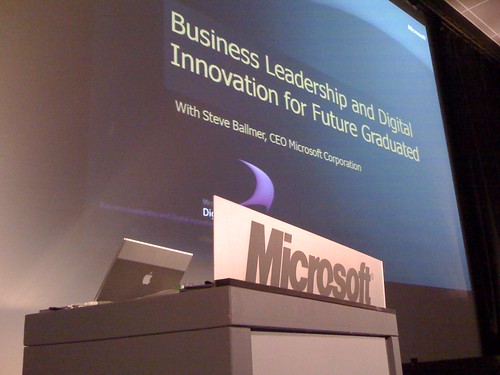
What laptop does Steve Ballmer use for his presentations? Right...
read more | digg story
Monday, April 28, 2008
What laptop does Steve Ballmer use for his presentations?


Beating Procrastination is Easy – Once You Get Moving
An important aspect of any self improvement program is learning to overcome the fine art of procrastination. Some people are able to casually avoid an unpleasant or difficult chore, while others go to extreme lengths devising outlandish mechanisms for escaping their responsibilities. In many cases, the effort spent avoiding the task far exceeds.
# Unfinished Business Causes Stress: No matter how steadfastly you try to ignore those unpleasant responsibilities, the fact is they are not going to go away without your attention. One of the goals of any effort towards achieving self improvement is the ability to reduce stress – but until you learn to overcome your procrastination, any unfinished business will add stress to your life.
Undone tasks will lurk in the back of your mind, causing you to feel guilt and frustration. You will be ill at ease until you finally get around to completing any unfinished business you may have. As unpleasant as it may be, you need to dig in and make sure you address each and every responsibility and task in your life. Failure to do so will undermine any effort you make at achieving relaxation and fulfillment.
# Make the Most Difficult Tasks Your Priority: One of the best ways to get past your mental roadblocks regarding certain tasks is to move them to the top of your priority list and focus all of your energy on them. Make them your first accomplishments of the day, the week, or the month. Once you dive in and finish them, you can clear them off of your calendar, take a deep breath, and go about the rest of your business with a clear mind and a light heart.
By tackling the hardest things first, you complete them with and energetic body and a refreshed attitude, giving you the greatest chances of achieving success. You will feel a sense of great accomplishment, and somehow the rest of your chores will not seem so difficult.
# Just Do It: The easiest way to beat procrastination once and for all is to commit to just getting it done. Choose a starting point and dig in with both hands. If it helps, break your major tasks into smaller parts, creating a succession of smaller tasks that lead to the fulfillment of one major task. Breaking it down into smaller parts is a great mind trick that fools you into thinking you are completing something much easier than the original project appeared to be.
Once you know where you are going to start, then get moving. They say to have to walk before you can run, so just take it slowly and accomplish one step at a time. As you complete each step, take a moment to acknowledge your progress, then continue on. Do not allow yourself to become sidetracked, which is really just another avoidance mechanism. Commit to keeping yourself on task until the entire project is complete.
read more | digg story
Sunday, April 27, 2008
Monetizing Blogger
Blogger is probably the easiest blogging platform to monetize. Why? Basically because it's Google-powered and it has page elements that make it easy for you to customize your blog, as well as an Adsense page element.
Google AdSense is a fast and easy way for website publishers of all sizes to display relevant Google ads on their website's content pages and earn money. Because the ads are related to what your visitors are looking for on your site — or matched to the characteristics and interests of the visitors your content attracts — you'll finally have a way to both monetize and enhance your content pages.
It's also a way for website publishers to provide Google web and site search to their visitors, and to earn money by displaying Google ads on the search results pages.
Get it? If you had a site, even a free-hosted blog such as this one, you can be a publisher of their ads and earn money through it. I haven't cracked the Adsense code yet, and still in the process of fully understanding it, but I have earned something through it. Right now, I'm not planning on becoming a full-time publisher of the ads just yet, but God-willing, if my predictions are gonna be right, I might not have to have a job anymore and just live off of Adsense.
I can't go in-depth with discussing Adsense right now, because that would veer away from the broader topic, which is monetizing Blogger. I might as well just make a little list of what I know so far.
Monetize via:
1. Adsense
2. Any other ad publishing sites
3. Paid Posts
4. Affiliate Marketing
5. Selling your own products
About ad-publishing, please, I mean, PLEASE, read the Terms of Service before agreeing to it. This is so that just in case you think of something, you would know that it is either in violation or not of the TOS.
For example, if you are a publisher of Adsense and of course you find out that you get paid via clicks on your ads and then you have this epiphany of wanting to click your own ads in hopes of generating income for yourself. This is what I have to say about it.
DO NOT EVEN DARE HOVERING YOUR MOUSE POINTER OVER YOUR OWN ADS! ESPECIALLY IF YOU ARE PLANNING TO CLICK ON THEM.
Seriously, you don't want to be banned by Google for violating their TOS. If you continue to "fool" Google by clicking on your own ads, chances are the advertisers are wasting their money advertising their sites for bogus clicks, and Google has very low tolerance about false clicks. I stated above to not even dare to hover your mouse above the ads, because well, accidental clicks happen, and well, you know that sh*t happens too.
Wow, this is turning out to be a long series of posts. Stay tuned for more. I am so not done yet.
read more | digg story
iBand makes music with two fingers and iPhone
VIENNA, AUSTRIA - SIX fingers and three iPhones are enough to create a band, and Austria's iBand is living proof, having scored a hit on the Internet by converting the little gadgets into a guitar, a keyboard and a set of drums.
The Viennese trio first gained attention in February on the video-sharing website YouTube with its music video "Life is greater than the Internet."
The clip, showing a bird's eye view of six hands wearing fingerless gloves and typing away at three touchscreens, has since been viewed over 2.8 million times.
"It was a test, we were rather surprised by all these viewings, but of course it's flattering," Seb, the "drummer," told AFP.
Fascinated by the pocket-sized gadget's possibilities, the three members of the band, all in their mid-20s, imported Apple iPhones as soon as they went on sale in the United States in December and began experimenting with the accompanying software.
"The idea was there even before the software existed," said Marina, an arts and communication student who is the band's singer and "pianist."
The iPhone is very easy to play, says the band, which has composed three pop songs.
"Of course the screen isn't very big and it doesn't have all the advantages of a real instrument," says Marina's brother Roger, the band's "guitarist".
"But I can change the settings any way I please. For instance, I can play two different notes on the same guitar chord at the same time. And as long as there are new programmes, there will be new sounds," he added.
read more | digg story
Thursday, April 24, 2008
The 4 Laws of Simplicity, and How to Apply Them to Life
The problem with many books and guides on simplifying your clutter, your work life, your desk, your life, is that they are usually too darn complicated.
1. Collect. Take out everything and put it in a pile. Empty the entire drawer, and pile it all on a counter or a table. Take everything out, down to the last paper clip.
2. Choose. Pick out only the few things you love and use and that are important to you. Just sort through the pile, picking out the really essential stuff. Be very selective. Put the important stuff you pick out into a separate, smaller pile.
3. Eliminate. Toss the rest out. You know you’ll never need those manuals again. Don’t be sentimental with this step. Either throw everything into a big trash bag, or find a new home for some of the items if you think someone might have a use for them - donate them to charity or give them to a friend who would love them. And yes, you have to toss out all the chopsticks.
4. Organize. Put back the essential things, neatly, with space around things. Clean the drawer out first, of course, and put the very small pile of things you chose back in the drawer, grouping like things together and leaving space around the groups. Having space around things makes everything look neater and simpler.
That’s it. You now have a very nice, simplified junk drawer, with (let’s hope) a much less funky smell.
This simple method can be applied to every area of your life. My suggestion is to focus on one area at a time, apply the method, and then move to the next area. So, if you just wanted to simplify a couple areas of your life, you could focus on one per week, but if you wanted to simplify your entire life, I’d do one area every couple of days until you’re done.
Here are some examples of how you could apply the above method to other areas of your life:
read more | digg story
Tuesday, April 22, 2008
2 Simple Ingredients to Boost Your Morning Energy
Realizing that money is tight and time is tighter, let's discuss a quick workout that doesn't cost a penny and can be knocked out in no time. Short and free, this routine will boost your morning energy level exponentially, especially if your current workout only consists of a shower.
When you get up, right after you eat your breakfast, do this push up routine:
1. Muster up some will, get down and pump out as many push ups as you can do.
2. Wait 30 seconds
3. Pump out more push ups (again as many as you can do)
4. Wait 30 seconds
5. Pump out more pushups (again as many as you can do and don't hold back… really push it!)
When you are done and you stand up, whatever the tired, sluggish, or "get out of my face" morning feeling you might have felt will have been replaced with an "I am the shiznit!!!" feeling.
Don't be surprised if you feel like pumping out a fast core routine. In fact go for it!
Here is a quick Core Routine that you can do:
1. Lie down on the floor
2. Lift your feet off the floor to about 6 inches while keeping your lower back on the floor
3. Scissor kick for 1 minute
4. Rest 30 seconds
5. Scissor kick for another minute
Good for you. You have done more than 99% of people typically do in the morning. It will also follow you into your day and make you be a lot more productive.
Not only have you eaten a great tasty breakfast that has revved up your metabolism, but you have shocked your muscles and woken them up to further boost your metabolism. Hey you are feeling pretty darn great… get off to work and kick some butt; life is good.
You just went through the ultimate morning… if you are one of the few that workout in the morning, don't worry I have something of for you too.
read more | digg story
Sunday, April 20, 2008
True Happiness: No Laughing Matter


 “I laughed so hard, I cried.” When was the last time you made that statement and really meant it; when you laughed so hard tears welled in your eyes?
What does it take to be a truly happy person?
Being happy and reaping the rewards of happiness does not mean adopting a “Pollyanna” attitude. It is not smiling on the outside when you are really churning on the inside. Real happiness has more to do with effort than attitude.
In her study [.pdf], “Achieving sustainable gains in happiness: change your actions not your circumstances,” Dr. Lyubomirsky found that the secret to happiness is hard work not “quick-fixes,” and compulsive self-gratification.
“Effort and hard work offer the most promising route to happiness….engagement in activities that promote one’s highest potential…enterprise, exploration of one’s interests and overcoming obstacles are the secret to happiness.”
Be happier by working harder? It sounds like an oxymoron! Most of us believe the opposite…work less and we’ll be happier, but that isn’t what the research suggests. The key to true happiness is to work at what you do best; do the work you are meant to do.
Remember the book, “Do what you love, the money will follow: Discovering your right livelihood?” It advances the idea that we should follow our heart to make a living. Dedicating your life to work that does not enhance your unique gifts it generates dissatisfaction and stress, not happiness. Work at what you do best, devote yourself to that effort, and happiness will be the logical result; not doing less of what you dislike, but doing more of what you love.
Doing what you dislike also thwarts creativity and hinders helpfulness. If you are unhappy doing what your doing, it is improbable that you will want to share your work or feel energized to apply creative effort. Dr. Lyubomirsky describes happy people as more creative, helpful, and self-confident. Confidence builds when we work creatively at what we are meant to do, and then selflessly share our work with others. The pattern emerges: do what you love and creativity, confidence and helpfulness follows. You will be happier.
read more | digg story
Friday, April 18, 2008
Managing Life Changes
Managing Life Changes
It's funny that in such a constantly-changing world that not more of us have naturally developed the aptitude to deal with it more effectively. Or has our love for consistency evolved as a defense against the reality of an ever-shifting world? Has our fear of change compelled us to construct schedules, routines, limits and borders? Is this an attempt to delay change?
Whatever the reason, it certainly seems odd that human beings are not more biologically-wired to deal with change. Sure, some of us seem to thrive on constant change, but most of us are undoubtedly more comfortable with consistency. For some of us, the fear of change can be downright crippling, so how can we learn to manage change more effectively?
Well, first it's important to understand what our stress over change comes from. This stress essentially is our body telling our mind that there's something we need to deal with that we have not experienced before, that we may need to adapt to, and that we may not be adequately prepared for. So what does this tell us?
Firstly, that we need to keep ourselves prepared for change. This means keeping our mind and body in optimum condition to deal with any adjustments. Which means eating right, keeping fit, and getting enough sleep. That takes care of our body; as for our mind, we need to maintain its resource level at a healthy high. This entails maintaining a store of knowledge, and regularly challenging our mind to think quickly and creatively. We can do this by reading widely, and by interacting with people whom we find intellectually-challenging.
We also need to develop some relaxation techniques that we can regularly balance our spirit with, and even use when confronting the change itself. You'll have to find what works for you, but for most people, this simple trick seems to work - most of the time, when we're stressed, our breathing inadvertently becomes faster and that actually stresses us even more.
So when in a stressful situation, try focusing on and slowing down your breathing. Imagine the progress of each breath as drawing one side of a square and make each line last four seconds. Inhale, 2, 3, 4, and exhale, 2, 3, 4... and repeat. You'll find yourself becoming calmer. Other people swear by meditation, yoga, journaling, walking or listening to soothing music.
And when potentially faced with a stressful change, try to get a clearer picture of it. The more you understand something, the less frightening it usually becomes. This is how, over time, we become familiar with initially-strange surroundings as well.
And finally, ask yourself "What's the worst that can happen, really?" You'll find that most of the time, the consequences aren't that bad. They're not something you can't live down. Besides, with change comes other possibilities that will actually be pleasant or beneficial for you. Try focusing on those.
A Slice of Life is written, produced and presented by Eugene Loh unless otherwise stated. If you wish to share the scripts with others, please credit 'Eugene Loh, 938LIVE, a station of MediaCorp Pte Ltd'.
Tuesday, April 15, 2008
6 Reasons Why Productivity Belongs To The Night Owls
In theory, your productivity level shouldn't differ if you rise at 4am or 11am. What matters is the quality of sleep that's giving your mind and body sufficient time to recover. So let's consider some reasons why burning the midnight oil may be more productive than waking up before sunrise.
1. Insomnia. The night owl will not go to sleep until they have hit a landmark in their productivity. They'll work into the wee hours of the morning, and later if they have to.
If going to sleep late is consistent for you, but you do it at the same hour each night, then you still benefit from the synchronization of your circadian rhythm.
2. Calmness. The night air is still and tranquil. No chirping, singing, or buzzing from the animals around you. When I say animals, I also mean humans. They've already gone to bed, leaving you with the peace to get done what you want to get done.
It's difficult, if not impossible, to get things done in the face of loud noise, honking horns, and other sounds of the day. The stillness of the night creates a clearing for ideas, innovation, and creativity.
3. Isolation. The calmness that I just mentioned is partly because no one is up. You create an atmosphere where you are separated from the schedules of other people, and thus isolated from their need for your attention. In essence you are operating on a distraction free basis.
You already know that it takes several minutes to get back into a state of flow after being distracted, so clearly when productivity is our ideal, distractions are our enemy.
4. An Agenda. Surprise, people get tired. If a person is going to stay up late to work, when they could have gone to sleep, they are clearly working on something of significant importance to them. Working on important things and being passionate about our work fuels us to an unbelievable extent.
This purpose, or worthwhile cause, is the emotional rocket fuel that guides us in maximizing our minds to achieve our goals.
5. Consistency. Night owls gain appreciation for the leaps they make in their productivity during the night. In this way they anchor their positive feelings of accomplishment with working at night.
Feeling accomplished is one of the greatest feelings, in fact is could feel better than any drug. This is why the night owl will consistently return to the productive underworld of the night, for productivity sake.
6. Minimal Multitasking. By now I'm sure you've heard that multitasking is not as productive as putting focused effort on one thing at a time. That's because being present allows us to get things done more quickly and in a higher quality fashion.
The night affords us with less outside pressure to multi-task. We'll able able to concentrate on that one super important task at hand.
What do you think, could you be productive this way? Are you already?
read more | digg story
Monday, April 14, 2008
The Wall Street Journal. What I Learned From Writing 1,008 Posts
As our columnist prepares for a new career, he takes on the biggest retirement-planning question of all: What is the reason for all this saving and investing?
1. If you have money, you don't have to worry about it. This isn't guaranteed. There are lots of rich folks who agonize constantly -- and needlessly -- about their finances. Still, if you save diligently, you should reach the point where money worries are relatively rare.
This feeling of financial serenity isn't, however, only for the wealthy. If you live beneath your means and invest prudently, you can achieve a sense of financial control long before you achieve full financial independence.
As I see it, this is yet another reason to follow my favorite investment strategy, which is to build a globally diversified portfolio of low-cost index funds.
If you are diversified, you don't have to fret about your wealth imploding because of a few disastrous stocks or a single rotten market. And if you buy index funds, you don't have to worry about badly lagging behind the market averages because you or your fund managers pick the wrong stocks.
2. Money can give you the freedom to pursue your passions. Ideally, you want to spend your days engaged in activities that you find absorbing and satisfying, that you feel you're good at -- and where you feel you're doing good.
Indeed, the happiest retirees are typically those who have a sense of purpose, whether it's volunteering for their pet cause, coaching a children's sports team, helping their church or returning to long-neglected studies. Retirement gives them a chance to pursue their passions without worrying about a paycheck.
But again, you don't need to be financially independent to have a sense of purpose. If you're young, you can pick a career that is close to your heart. If you're in your 40s and you have been saving for 15 or 20 years, maybe you can afford to swap into a new job that is less lucrative but more fulfilling.
3. Money can buy you time with friends and family. You don't just need a reason to get up in the morning. You also need somebody to come home to at night.
Studies have found that regularly seeing friends and family can provide a huge boost to happiness. Money helps in this regard, allowing you to go out to dinner with neighbors, travel to see old friends, take your family on vacation and go to the theater with your spouse. If you don't need to work or you only work part time, that will help further, giving you more hours to share with the folks you like best.
But while money makes all this easier, it clearly isn't a necessity. Disgruntled with your lot in life? My advice: Forget spending more money at the mall -- and instead spend more time with friends. Your bank account may still be skimpy, but your life will be far, far richer.
read more | digg story
What's the Point of Investing?
By Dr. Steve Sjuggerud
April 11, 2008
"Nice to meet you... Hang on a sec... Let me text my husband." My wife and I stand there waiting. The girl busily taps out a text message on her new iPhone.
She's not so quick with the typing, but we know what's going on... She's just showing off that she owns a $500 phone – hot stuff in rural Georgia. We saw her arrive... She drove a black Suburban of some sort, with enough chrome to make a Detroit drug dealer blush.
She and her husband are young... probably in their late twenties. He's apparently a builder in Georgia. Of course, homebuilding in Georgia died about two years ago... But even though their income must be down, their spending hasn't changed.
This young couple isn't the only one out here sporting an iPhone and a blingy black Suburban. What's going on here?
Me? I don't have an iPhone... Or a blingy Suburban... But I probably have one thing these conspicuous consumers don't: The house I live in is fully paid for.
I handle my money differently. I could buy an iPhone or a Suburban tomorrow. I wouldn't need a penny of debt to do it. But I won't... Why? Because I know those things won't make me the slightest bit happier. I'd be the same dolt I was before... only now, I'd be $50,000 poorer!
It took me a while to get to this point in my life. But I'm glad I made it... I'm at the point where I can buy what I want. But I don't. It's an important point to reach.
This brings me to the point of this essay... What's the point of saving money anyway? What's the point of investing?
When you get older (if you're not already older!) just what are you going to buy with that money you've saved?
Jonathan Clements gave a good answer to this in his farewell column for the Wall Street Journal this week (Clements has written more than 1,000 columns for the Wall Street Journal).
Clements says your savings "can deliver three key benefits." Even better, he says, "You can enjoy this trio of benefits even if you don't have great wads of cash." Here's how:
1. If you have money, you don't have to worry about it.
2. Money can give you the freedom to pursue your passions.
3. Money can buy you time with friends and family.
read more | digg story
Tuesday, April 8, 2008
7 Simple Ways To Burst Out of Bed Each Morning
Way before the sun peeks over the horizon, a few chosen people awaken from their slumber and dive head first into their day. These chosen few accomplish a ton before rest of us would ever consider rising from our nice warm beds. The world is in awe of these people, let's take a look at what pops them out of bed and what gets them up before alarm.
The world is in awe of these special people, so let's take a look at what pops them out of bed like a toaster strudel and what gets them up, sometimes before the alarm!
1. Appointment With Waking: The harsh truth about the human body is that we're creatures of habit. In some ways this can be extremely inconvenient when trying to take on new things. However, if we allow ourselves to live within the rules of our body's natural cycle, which is a 24-hour circadian rhythm, we will be pleased with the body's functionality.
This means that when you find a waking hour that will work best for you each day of the week, you should stick to it. This will allow your body to want to support you in your endeavor of waking up, and rise you out of bed feeling fresh as a daisy.
2. The King and The Pauper Way Of Eating: The way our bodies function optimally is if we eat like a king in the morning and a pauper in the evening. This means that it's best to eat heavier, bigger portions in the morning because these meals will give us high energy throughout the day and then burn off.
Eating like a pauper, meaning small light meals, in the evening allows us to go to sleep on an empty stomach. If your body is functioning normally, and you don't have stomach ulcers, going to sleep on a mostly empty stomach will allow you to sleep better. This nightly fast allows your body to take it's focus away from digestion and put it towards repair and rejuvenation of the body's cells.
3. Living With Purpose: Young children will do anything to avoid going to sleep at night. These same children are also the ones that can't wait to get out of bed first thing in the world. The simple reason for this non-lazy behavior is that they don't want to miss a thing.
As adults we may need more persuasion than 'not wanting to miss a thing'. This is why we take extra steps in creating fun, life changing goals, and scheduling specific ways of how we'll get a step closer to these goals during this coming day. What we all need is not necessary a cause we're willing to die for, but at least a cause we're willing to LIVE for.
4. Plan Your Day: We can say we're going to live with purpose, but unless we plan, we can tell ourselves that we'll start living with purpose next week, or the week after that. Planning is one of the fundamental ways to maximize your mind to achieve your goals, and as such it plays a critical role in allowing us to have an awesome day, everyday. We need not do more than take 15 minutes the night before to succinctly organize the next days schedule.
A schedule complete with waking time, most important things of the day, eating and recreational allowances. Having a tight schedule allows me to live out my day with definitive purpose, while getting more done, having more fun, and not wasting precious moments of my life.
“Happy people plan actions, they don't plan results” - Dennis Wholey
read more | digg story
Wednesday, April 2, 2008
4 Defense Strategies to Becoming A Millionaire
What type of mindset do you have to have in order to become a millionaire? First off, let me say that I am a firm believer that in order to reach a goal you must first be the specific person, that takes the actions, that reach that goal. Be, do, have! I'm also a firm believer that one is much better off learning proper money management techniques.
Defensive Money Strategies from Real Millionaires
1. House Purchases. Real Millionaires do not get houses custom built, nor do they move into new developments. They live in clusters with each other in OLD neighborhoods, in OLD houses. Most are 15 years old and they often triple in price since their purchases.
2. Clothing Purchases. They aren't going to buy really expensive clothes. They may frequent thrift shops or even Walmart to get their clothes. So don't be embarrassed to go cheap, just think of it as acting like a millionaire. They will buy really expensive shoes, and resole them when necessary. Since they'll wear them for a couple of decades the cost per wear will be marginal compared to constantly replacing a cheap pair.
3. Furniture Purchases. Real millionaires do not buy the latest styled furniture. They'll go out and buy a $10,000 antique table made from REAL wood, not modern saw dust. They'll repair and refinish this table when needed. They can keep it for a lifetime, pass it on to their children, and not worry about upgrading to the latest. Guess what? Antiques raise in value, so their net worth doesn't take a hit at all! As far as other furniture goes, they re-upholster it a couple of times in their life time, which is way cheaper than buying new again.
4. Vehicle Purchases. Real millionaires will not buy the latest car while it's still sitting on the lot. They'll keep their cars well maintained for many years, and when it comes to make a new purchase they'll find a used car that is in good condition. This way they can avoid that initial depreciation that comes with driving a brand new car off the lot.
First Cost Vs. Life Cycle Cost Defense Strategy
This applies to the amount of money that can be saved when purchasing an item, versus how much fixing and replacing this item will cost over a life time. The furniture purchases and shoe purchases I mention above are pretty good examples, but it can apply to many other situations as well.
A good example that Dr. Stanley used was in the case of paying a plumber to do some work for you. You might be able to buy a cheaper boiler, install it yourself, and save a few hundred dollars. However, you aren't thinking about the big picture.
read more | digg story
Don't waste money trying to groom your kid to be another Einstein
Engage your kids personally. Don’t let them be bored with nothing to do or stressed out with too many "enriching" lessons.
JENNIFER, a corporate communications manager, recently bought a baby grand piano. She didn’t have enough cash for an outright payment, so she takes up an installment plan.
"When I was a kid, I was made to learn the piano till I passed the Grade 8 exam," she says. Grade 8 is about the highest for piano students. "But when I began working I lost interest in the piano. Now, after so many years, I want to practise again, so that what I’ve learnt would not be permanently lost," she says, explaining her expensive purchase.
Jennifer is fortunate that the piano lessons she was forced to take when she was small did create an interest in music in adult life. Not many grown-ups, however, continue to show interest in those pricey "life enrichment" activities of their childhood.
Ballet, sailing, French, gymnastics, the piano, Chinese calligraphy, and, for crying out loud, the harp! Children are kept busy after school in a breathless round of such activities. Parents hope that these so-called life-enriching lessons will help develop the child with, say, a bit of Albert Einstein (his brain, not his looks) and Marilyn Monroe (her looks, not her brain).
Too often, the kid is not asked if they are really interested. Now that prices are going up for both basic necessities and luxuries, parents should consider carefully they should continue shelling out cash on lessons and activities that their children have little or no aptitude and appetite for. Worse, some of the enrichments do not have long-time realistic benefits.
Consider French lessons and ballet dancing. Unless you are planning for your kid to go work in France as a professional ballerina, why on earth do you want her to learn these subjects?
Instead of leaving your child with an expensive tutor, a less-kiasu and more productive approach is to spend your own time doing activities with your child. Here are some suggested do-together activities that can be planned on a regular basis for primary school-going children and parents:
♥ Brushing up on your Mandarin (or Malay, depending on the second language that your child is required to learn in school). Take your child to the super mart to buy groceries and other food items. Back home, spread your purchases on the kitchen table, and with the help of a Chinese dictionary, identify and write the Chinese names for each item.
You can even turn it into a memory game. After you have written the list, both of you memorise it, and then write all the names again, from memory. The one who scores worse must wash the dishes after meal.
♥ Memorise a poem. Both of you pick your own poem (from a book of poetry or from the Internet), then give yourself a week to memorise it. At the end of the week, recite the poem from memory, to each other, and to the rest of the family. Bonus points if either of you can explain the poem in your own words! For starters, look for poems by Robert Frost and Elizabeth Bishop.
Note: Do not make the mistake of limiting poems to "childish" ones. Children are often smarter than you think, and excellent poetry can be understood and appreciated by readers big and small. Try this poem, which talks of everyday occurrences:
Tuesday, April 1, 2008
Awesome Dutch E-Commerce Site - http://producten.hema.nl/
E-commerce site with a sense of humour! Definitely worth a visit!
http://producten.hema.nl/
read more | digg story
Subscribe to:
Posts (Atom)